Your contact center is drowning in call duration. Every extra minute costs money you can't afford to lose.
A customer calls with a billing question. The agent searches for information. The customer waits on hold. Notes get typed manually. Then the next customer enters the queue. Meanwhile, your operational costs climb, and agent frustration builds.
Average Handle Time (AHT) is destroying your profitability while you measure it in seconds. Most of the Telecom operations teams often put high focus on reducing AHT without addressing root causes, agents rush through interactions, customer satisfaction tanks, and repeat calls multiply.
So What Exactly Is Average Handle Time?
Average Handle Time (AHT) is a core contact center metric measuring the average duration agents take to handle a call or transaction from start to finish. It's straightforward to calculate but profound in its implications.
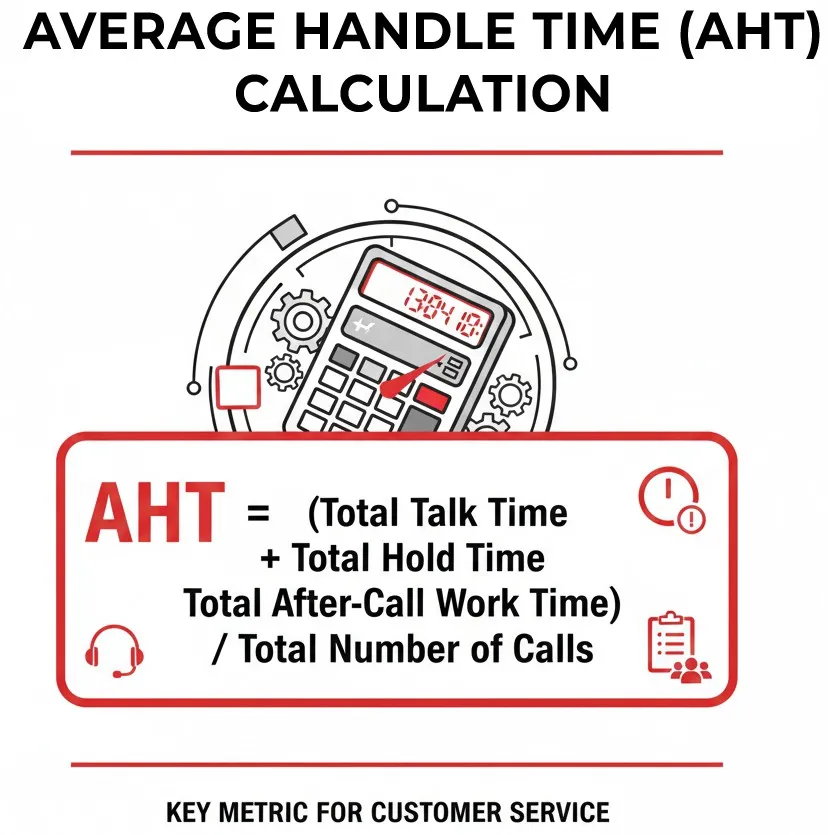
For example, imagine your contact center handles 120 calls in a day:
- Total talk time: 900 minutes
- Total hold time: 650 minutes
- Total follow-up time: 250 minute
The AHT formula for yesterday’s calls would be: (900 + 650 + 250) / 120 = 15 minutes
In this example, your average handle time would be 15 minutes per call — nine minutes higher than the industry benchmark of six minutes — suggesting opportunities for optimization. The three components matter equally:
- Talk time (70%): Agent actively engaged with customer
- Hold time (15%): Customer waiting
- Wrap-up time (15%): Post-call documentation, notes, system updates
Many contact centres optimise talk time while ignoring hold time and wrap-up work—creating misleading metrics that hide inefficiency.
What's a Good AHT Benchmark?
Industry standards vary dramatically by sector and complexity. Here are some estimates of standard industry benchmarks:
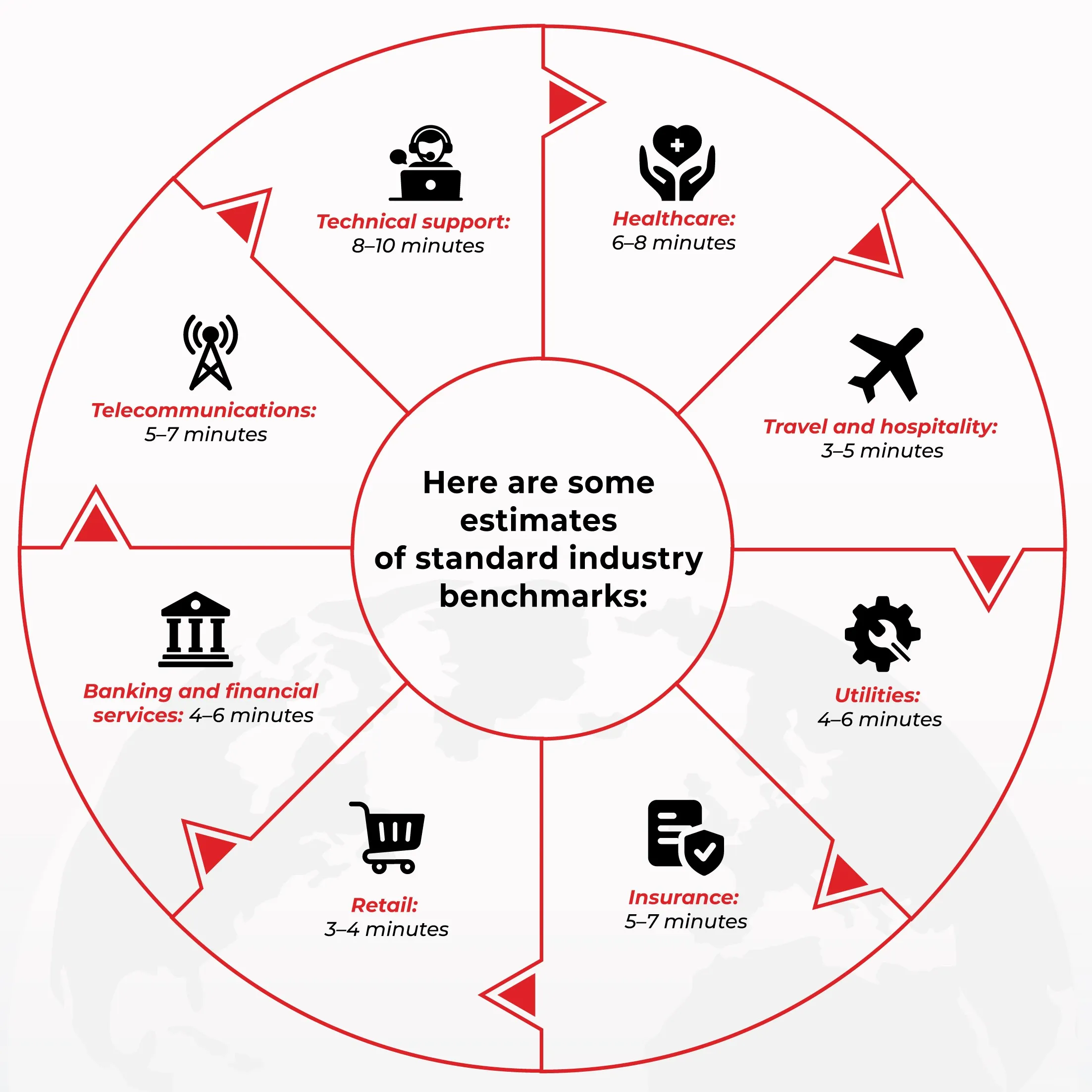
A critical insight: AHT has nearly doubled from 2004 to 2022, rising from 220 seconds to 426 seconds. This isn't agent laziness. It reflects the reality that self-service has absorbed simple inquiries, leaving contact centres handling increasingly complex issues that demand time.
Why AHT Matters: But Not for the Reason You Think
The conventional wisdom about AHT is dangerously incomplete. Shorter isn't always better.
The False Tradeoff: Speed vs. Quality
Here's what happens when you optimize AHT without balancing quality: agents rush through calls, customers don't feel heard, issues go unresolved, and repeat contacts multiply. You reduced AHT on paper while increasing total customer effort and operational costs.
Some customers might prefer complete solutions even if it takes more time - some might not. But a solution with speed that sacrifices resolution is counterproductive.
The Real Value: Efficient Operations
When you optimize AHT intelligently—by eliminating system friction, improving agent knowledge, and streamlining workflows—the benefits cascade:
- Reduced Operational Costs: Lower AHT translates directly to lower cost per call. Agents handling more interactions per shift without rushing means you can serve more customers with the same staffing.
- Increased Agent Efficiency: Agents who resolve issues effectively on first contact experience accomplishment and motivation. They handle more interactions, develop broader skills, and tackle complex issues with confidence.
- Improved Staffing Flexibility: AHT data enables accurate workforce forecasting. Understanding typical resolution times helps managers predict staffing needs and optimize schedules.
- Enhanced Retention: Long, complex interactions contribute to agent burnout and turnover. When agents can resolve issues efficiently—without feeling rushed—stress decreases, and job satisfaction improves.
How to Measure AHT Accurately
Measurement precision determines improvement capability. Here's the step-by-step process:
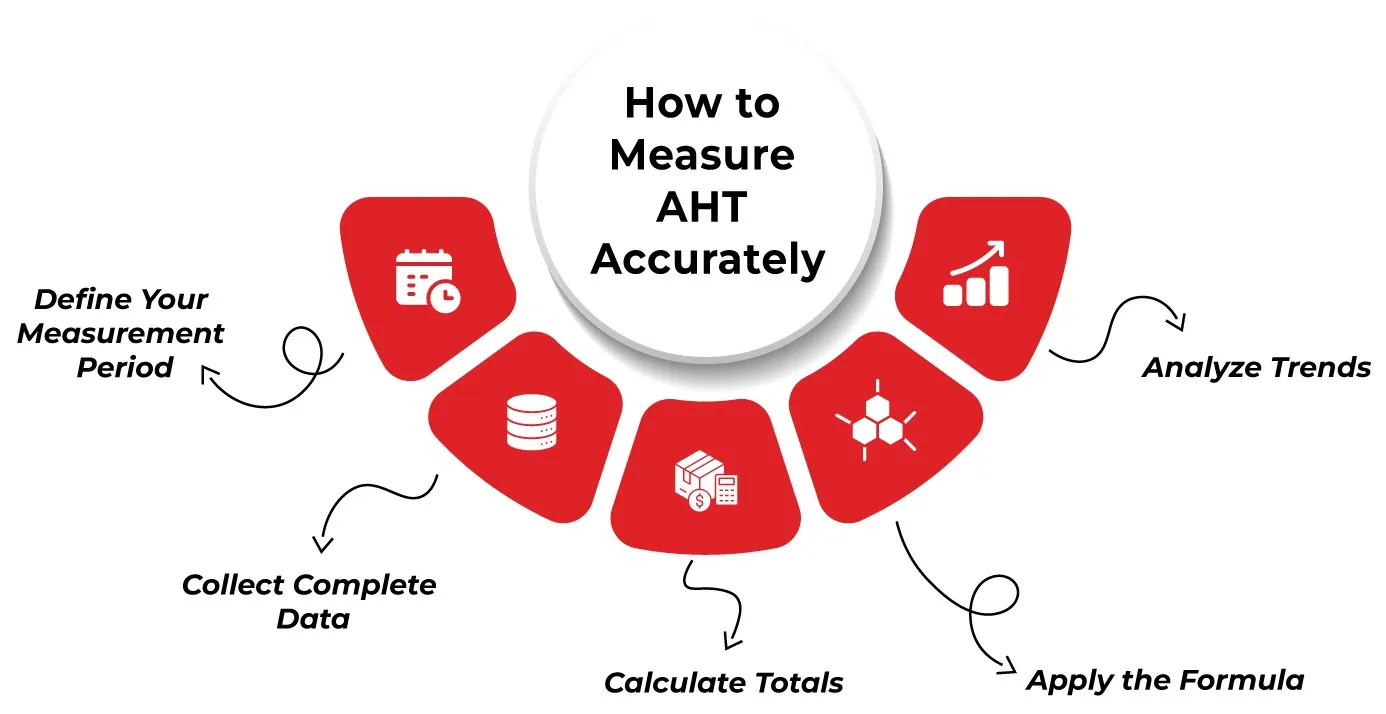
Step 1: Define Your Measurement Period
Choose daily, weekly, or monthly tracking. Most organizations measure weekly or monthly to smooth out daily fluctuations.
Step 2: Collect Complete Data
Track three components for every call:
- Talk time: When the agent is speaking to the customer
- Hold time: When the customer is waiting
- After-call work: Documentation, notes, system updates, scheduling follow-ups
Many contact centers fail here. They track talk time accurately but ignore hold time and wrap-up work, creating incomplete metrics.
Step 3: Calculate Totals
Add all three time components across every call in your measurement period.
Step 4: Apply the Formula
Divide the total time by the number of calls handled. That's your AHT.
Step 5: Analyze Trends
Don't obsess over daily fluctuations. Track weekly or monthly trends to identify patterns. Compare against industry benchmarks for your sector and call type.
Pro Tip: Use advanced call center software that automatically records and calculates AHT. Manual calculation introduces errors and consumes management time.
How to Improve AHT: The OmniTel360 Way
Reducing AHT without sacrificing quality requires eliminating the real culprits: system constraints, information access delays, and process inefficiency. How?
- Eliminate Screen-Hopping With Complete Customer Visibility: Agents toggle between CRM, billing system, knowledge base, and email, looking for answers while customers wait on hold.
OmniTel360 changes this dynamic entirely. A unified 360° customer view displays everything on a single screen—billing status, service history, provisioning details, interaction records, payment history, and balance information. Agents access the complete context instantly. No search delays. No hold time. No confusion.
- Provide Real-Time Agent Assistance: Complex billing questions? Dispute resolution? Policy exceptions? Agents shouldn't search knowledge bases while customers wait.
OmniTel360's Gen AI provides instant answers during live calls. Agents ask questions in plain English—"Show me all dispute resolution cases from this week"—and receive detailed information instantly. No SQL. No technical knowledge required. Just immediate access to answers that would have required manual research.
One more essential point: AHT targets that damage quality are counterproductive. Your job is balanced optimization.
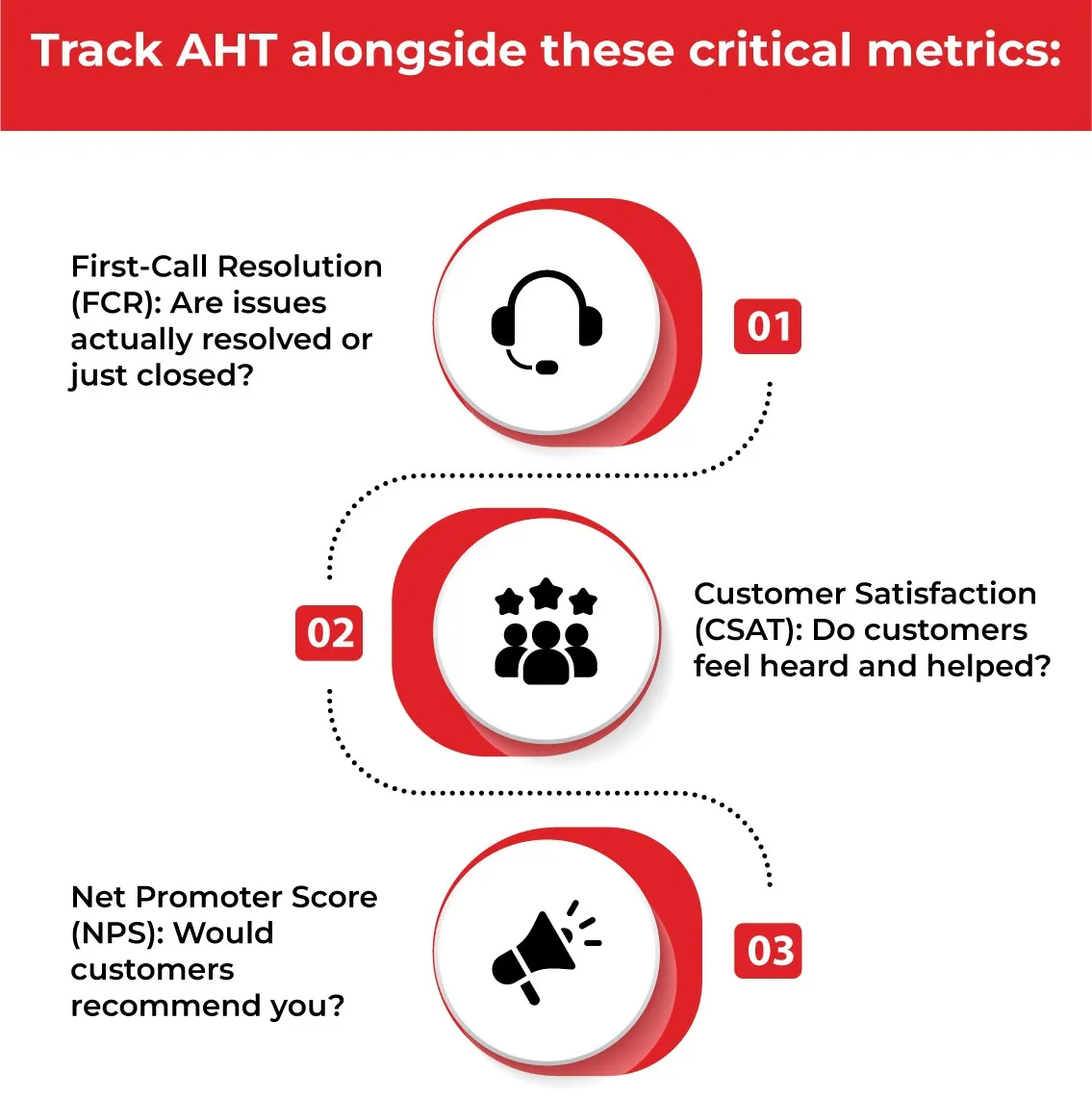
If AHT improves while FCR, CSAT, and NPS decline, you've optimized in the wrong direction. The goal is reduced AHT that maintains or improves quality—not speed at any cost.
Stop Sacrificing Quality for Speed. Start Optimizing AHT Intelligently.
Smart AHT reduction requires eliminating system constraints, empowering agents with complete information, and automating manual work—not rushing agents through interactions.

Register for a live demo with Aarav Solutions today
and discover how OmniTel360 reduces Average Handle Time while dramatically improving first-call resolution, customer satisfaction, and operational efficiency. Transform AHT from a cost driver into a competitive advantage.